
The Cost of Search Failure: A MedTech Leader’s Guide to Strategic Talent Intelligence
The most successful MedTech leaders in 2026 treat talent acquisition like an insurance policy

An empty territory for six months is a direct hit to market share.
Most MedTech organisations only start searching after the resignation letter lands. By then the cost is already running — lost revenue, disrupted accounts, and a search process launched under pressure rather than on strategy.
In a market defined by specialist expertise and relationship-led sales, reactive hiring isn’t just inefficient. It’s a revenue risk.
The five patterns below are the most common failure points I see in MedTech hiring.
Not because hiring leaders lack capability — but because the process they’re using was built for a different market.

1. The Hidden Cost ( of Reactive Hiring )
Most organisations engage a recruiter once a vacancy exists. In MedTech, where specialist capability takes months to develop and territory relationships are hard-won, that timing is already too late.
The talent that would make the most difference — high-performing professionals currently hitting their targets at a competitor — will never see your job ad. They’re not looking. They don’t need to be. They’re invisible to any process that starts with a job board.
A recurring pattern in recent market conversations: senior commercial talent becoming available through restructure, wind-down or role reconfiguration — not advertising, not applying. The organisations best positioned to act were those already aware of the talent landscape before the vacancy appeared. Those starting from zero when the role opened lost weeks they didn't have.
The Shift: The shift required isn't just faster hiring. It's earlier visibility.
Understanding who exists in the relevant talent pool before a need becomes urgent is what separates a structured search from a reactive scramble.
2. The Internal-Only Trap: Why Familiarity Stifles Innovation
When a senior role opens, many leaders default to internal promotion. The instinct is understandable — loyalty, cultural fit, reduced onboarding friction.
The risk is less visible: organisations that hire exclusively from within develop a narrowing view of what good looks like. External mid-career leaders bring different commercial playbooks, competitor intelligence, and market relationships.
In a period defined by reimbursement reform, margin pressure and procurement complexity, that external perspective often carries more value than the familiarity of a known internal candidate.
The Reality: The strongest hiring decisions tend to combine internal pipeline awareness with an honest view of what the external market holds.
That requires actually mapping the external market — not assuming it.
3. What talent actually wants in 2026
The candidate value proposition has shifted.
Mid to senior MedTech professionals in 2026 are not making decisions based on perks, culture statements or flexible working policies alone. They are assessing commercial viability, technical pipeline, leadership quality, and — where available — equity or meaningful bonus structure.
In conversations with ANZ MedTech professionals over the past six months, the consistent driver isn't dissatisfaction with compensation — it's a structural shift: a restructure, a reporting line that no longer works, a role scope that no longer matches where the person has grown. Nobody is moving for free coffee.
The Employee Value Proposition for a senior MedTech role needs to function as a business case, not a lifestyle pitch. If you can’t articulate why this role represents a genuine commercial opportunity for the right person — including what the territory looks like, what the growth trajectory is, and what the realistic earnings ceiling is — the strongest candidates will decline to progress.
The Strategy: Offer calibration before you go to market matters. A role positioned incorrectly loses candidates at the point of interest, not at the point of offer.
4. Replacing gut feel with structured assessment
“Seems like a good fit” is not an assessment framework.
In high-stakes MedTech hiring — senior commercial roles, leadership appointments, territory rebuilds — the cost of a wrong hire typically exceeds the annual salary of the position. Behavioural assessment for competencies specific to the role context — stakeholder mapping, commercial acumen, clinical credibility, resilience under financial pressure — is not optional at this level.
The Verdict: The QIA framework — Qualified, Interested, Assessed — is the standard applied in structured MedTech search. It replaces volume shortlisting with a disciplined process: candidates are only progressed when capability, motivation and risk profile have all been verified.
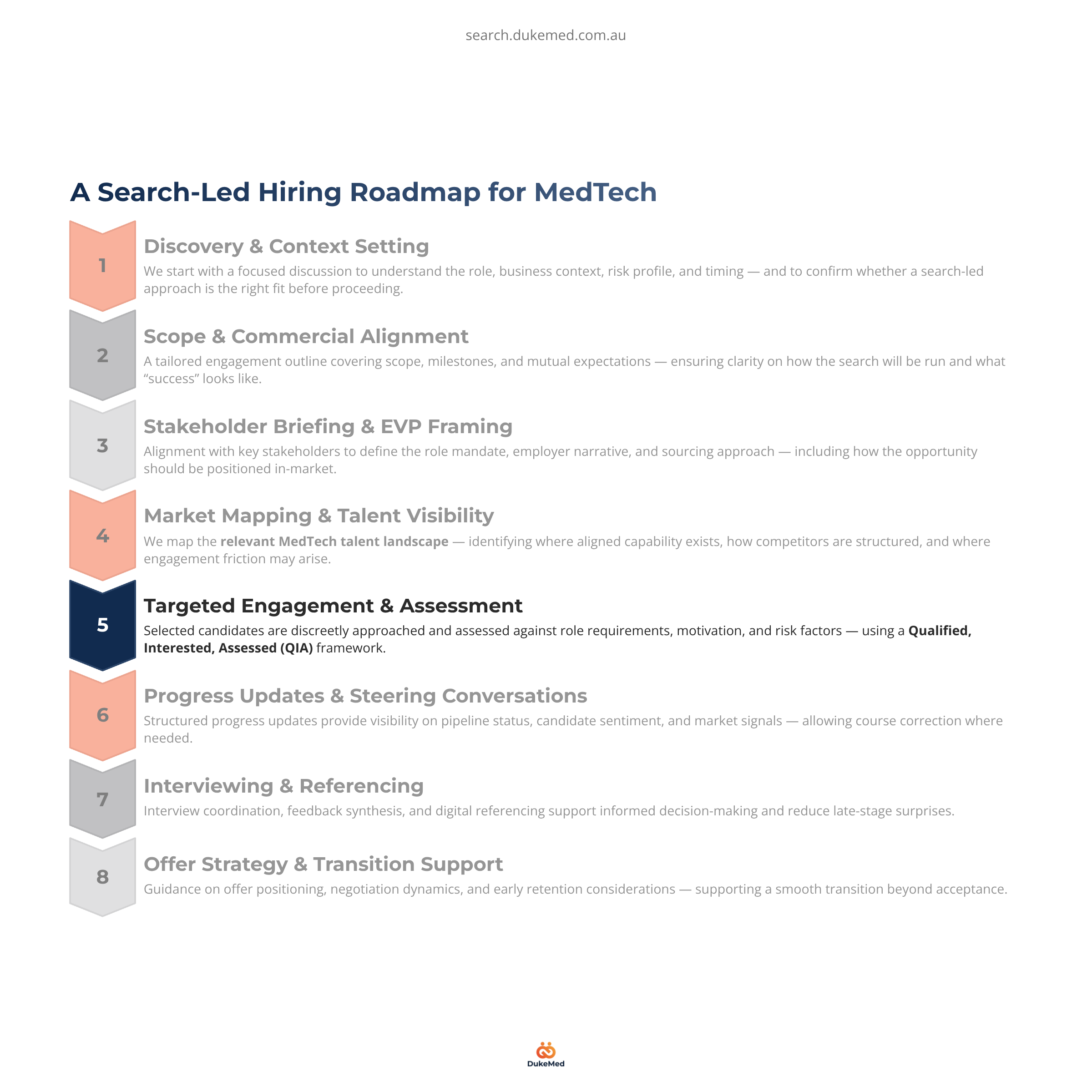
5. The Search-Led Insurance Policy-Treating search as a strategic asset
The MedTech leaders who consistently hire well don’t treat talent acquisition as a reactive function.
They treat it like an insurance policy — investing in market visibility before a need becomes urgent, so that when a transition occurs, the decision isn’t made under pressure.
That means knowing who exists in the relevant talent pool.
Understanding how competitors are structured. Having a clear view of candidate sentiment and what would prompt movement.
And being positioned to act quickly when the right person becomes available — rather than starting from zero when a vacancy opens.
In this market, the professionals who represent the strongest fit for senior ANZ MedTech roles are often already known — through prior relationships, referral networks, and direct conversation.
That pattern shows up consistently in structured search work. They surface through engagement, not job ads.
Search intelligence isn't a luxury for large organisations. In a niche market, it's the difference between filling a role well and filling it under duress.
The Bottom Line: If your current recruitment process relies on chance, you are leaving your market share to chance. In a high-stakes industry, “Good Enough” hiring is a strategy for stagnation.
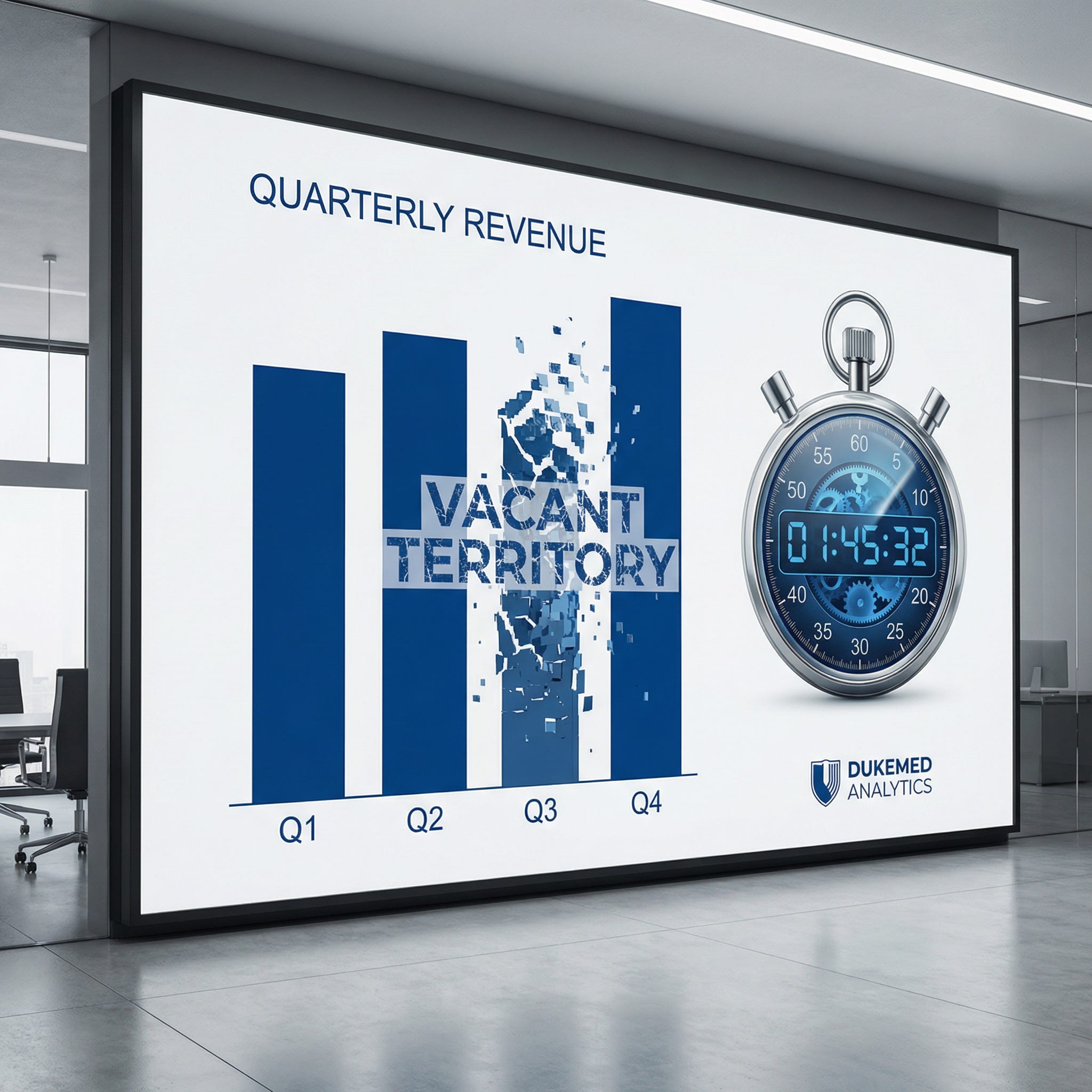
Is your hiring process built for 2022 or 2026?
Before committing to a search, it's worth understanding exactly where your visibility gaps are — in talent accessibility, offer calibration, and market perception.
The Pre-Hire Insight diagnostic identifies those gaps in a focused conversation, with no commitment required.