Every Recruiter Grades Your Vacancy — Here's the Score You Never See
You never see it happen, but in most recruitment agencies, every vacancy that lands gets graded the moment it arrives.

Recruiters privately grade every vacancy by fee, ease and effort.
Here's how that grading works, what it means for your MedTech hire, and a five-minute way to read your own role's difficulty before you commit to a search method.
Fee size. Ease of fill. How many other agencies are working the same role. How difficult the client is to deal with. It’s never written down anywhere a client sees, but it decides how much genuine effort a role gets from day one.
The grading system is a feature of the volume model — a recruiter running ten or fifteen live roles at once has no choice but to triage, and triage means some searches get the full push while others get a scaled-back version dressed up as business as usual.

I can describe this openly because I'm not grading your vacancy against fourteen others on my desk. There's only one search running at a time.
And the quiet part matters, because the grading criteria are actually a useful diagnostic — they’re just written in recruiter language nobody translates for you.
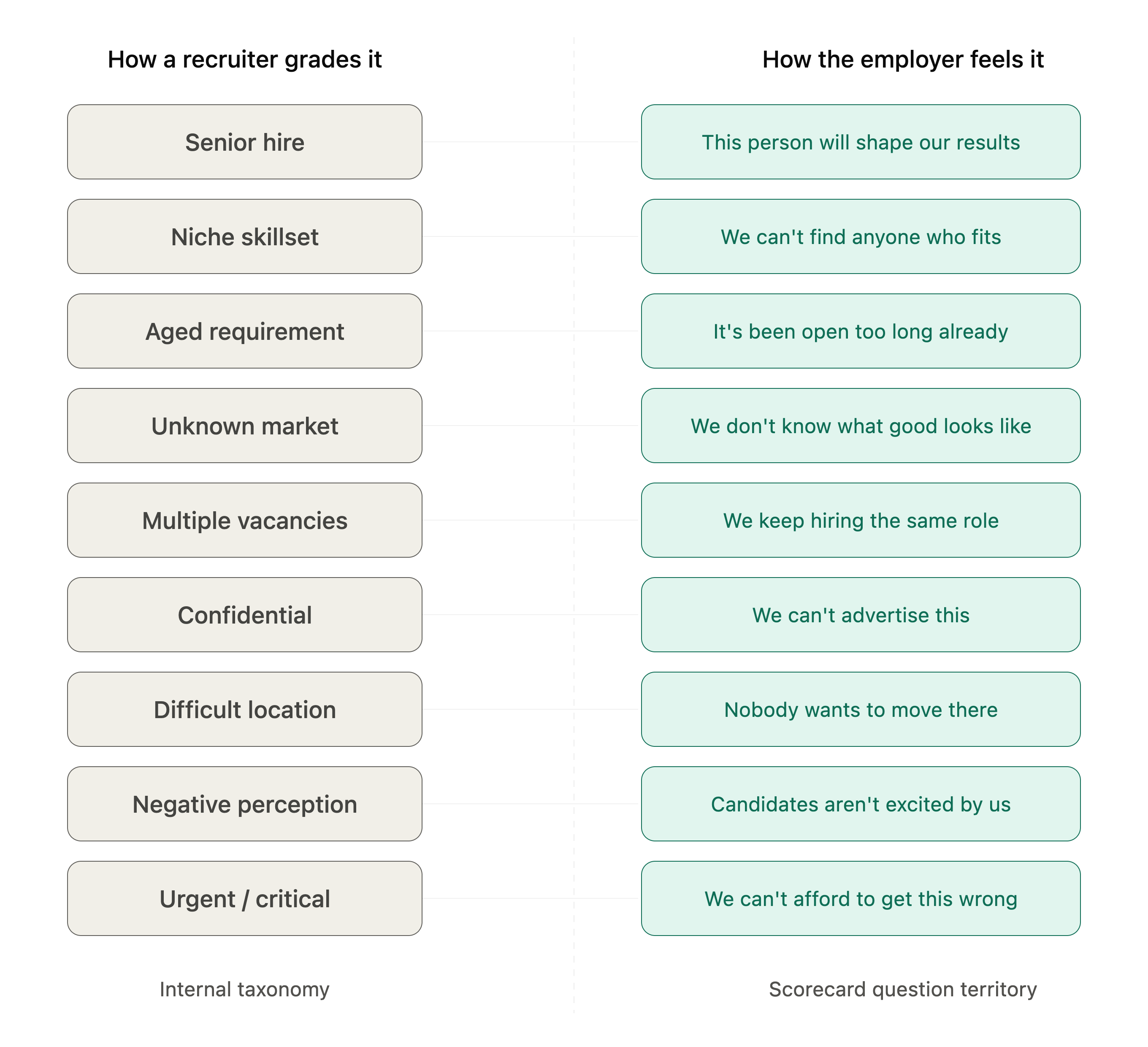
Senior hire → "this person will shape our results"
Niche skillset → "we can't find anyone who fits"
Aged requirement → "it's been open too long already"
Unknown market → "we don't know what good looks like"
Multiple vacancies → "we keep hiring the same role"
Confidential → "we can't advertise this"
Difficult location → "nobody wants to move there"
Negative perception → "candidates aren't excited by us"
Urgent, critical → "we can't afford to get this wrong"
Every line on the left is a reason a role slides down someone's priority list. Every line on the right is a reason it can't afford to.
So flip it. Before anyone grades your vacancy behind closed doors, grade it yourself
A genuinely routine role probably doesn’t need me or anyone like me.
A role with real complexity — thin market, hard constraints, history of falling over — needs a completely different approach, and sometimes the right first step isn’t a search at all.
Sometimes it’s simply getting visibility: who’s actually out there, what they’re paid, what would move them, why the last attempt didn’t land.
AI tools and DIY platforms are already soaking up the easy hiring. What's left over is disproportionately the hard stuff, and my read is that gap keeps widening, not closing.
This holds even if you never brief an agency again.
So before you choose a method, run the triage yourself.
How Hard Is This Hire? ( answer ten yes or no questions ) — business impact, your read on the market, practical obstacles, hiring history, and how confident you honestly are in the current plan.
A clear low, medium or high result with straight feedback on what’s driving it.
Walk into your next hiring conversation, with anyone, having already done the prework.

Intelligence first, method second.
A note on how DukeMed works: search runs one retained mandate at a time, by design. It's exclusive because it has to be, you can't work a confidential search for one MedTech employer while quietly representing a competitor's opening in the same category. Market intelligence work, mapping, salary and sentiment reports, sits outside that constraint and can run alongside it.